

Reducing Emissions from Deforestation and Degradation (REDD) is a mechanism that establishes incentives for developing countries to protect and better manage their forest resources by creating a financial value for sequestration of the carbon stored in forests. In this way, countries can gain more financial benefit from maintaining forests rather than cutting them for commercial logging or converting them to agricultural concessions. REDD+ goes beyond deforestation and degradation (DD) by including forest conservation, sustainable management of forests and enhancement of forest carbon stocks.
In addition, the Voluntary Carbon market provides opportunity for well conceived, implemented and managed projects to gain carbon offset credit revenues.
Three main techniques are used to quantify and measure carbon stock; remote sensing, field measurements and allometric models.
Remote sensing is used to measure DD through a recording device such as satellites. Through a series of images taken over the previous 20-year period, a baseline historical deforestation rate is identified and used to identify areas where DD is most rapid. A study of historical land use and land cover change is important because in the absence of the project, it is assumed that deforestation rates in the project area will be identical to the rates of historical deforestation. Reductions in DD emissions will result in carbon credits only if emissions drop below the relative baseline rate.
Field measurements are essential to provide actual measurements of carbon densities. Sampling data from targeted locations saves time by creating a means to infer carbon stocks for an entire forest area while measuring only a fraction of it. Carbon density values taken within these areas are used to provide carbon stock estimates.
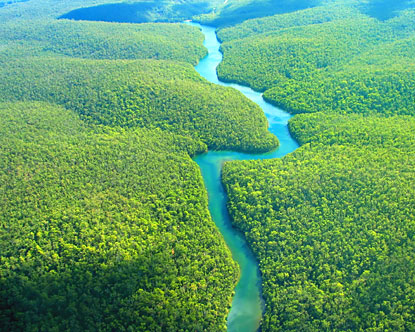
Undisturbed Tropical Rainforest
Allometric models are used to determine carbon stocks are determined based on site-specific relationships. These carbon stock estimates are then used to determine net rate of forest emissions by comparing the difference in carbon stocks in a particular area at two moments in time.
The deforestation and degradation of forest resources, at its core, is an issue of competing land uses. If the ‘opportunity cost’ of converting forestland into crops (land use change) is greater than the financial benefits gained from leaving the forest standing, REDD+ projects are likely to fail. Similarly, for a REDD+ project to be successful, the benefits (gained through REDD+ -the mitigation of GHG’s (Green House Gases) must be greater than the opportunity cost of alternative land uses.
Project Focus
Beginning in 2010, Aruna have been working closely with Forest Inventory and Planning Division (FIPD) at national level to provide technical support, training and QA/QC for production of national forest cover maps for 2005 and 2010 for use in REDD National Carbon Accounting System.
The scope of our activities and accomplishments are:
- Prepared provincial map of Luang Prabang to test integration of different high resolution sensors (ALOS, SPOT5 and RapidEye);
- Undertook pilot work to pre-process satellite imagery including research on techniques for haze reduction, cloud masking and radiometric correction and calibration;
- Assessing geometric and geographic accuracy, ground control requirements, quality, pre-processing requirements, time, costs and utility for forest cover mapping;
- Collecting ground control and field survey data, working with national staff and training them in survey sampling, design, participatory land use planning and field data collection, processing, storage and use;
- Work with FIPD to train them in image processing and classification and GIS software (ArcGIS, ERDAS, PCI and eCognition);
- Develop parameters and processes for automated image processing assembly line using object-based image segmentation and other image processing techniques for REDD forest and land cover mapping.